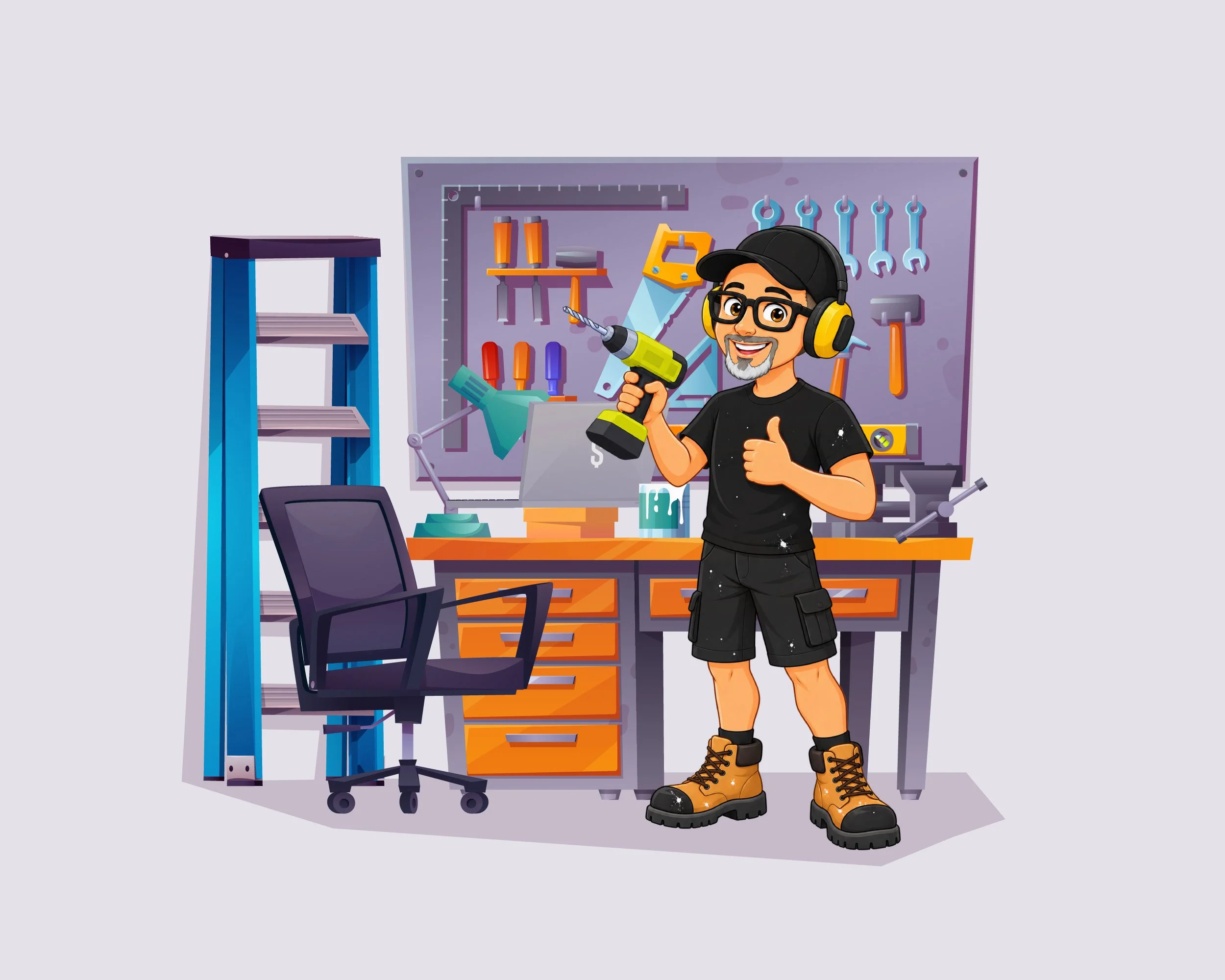
Jonny, How Is Retirement Going?
04 Oct, 2026
It’s Jonny here. Ruth has been asked this question a lot over the past couple of months:
“So, how is Jonny’s retirement going?”
The short answer is: excellent. And it’s probably easier that I, Jonny, answer the question and let Ruth get on with answering all the other questions she gets.
A couple of months ago, I left my two-day-a-week graphic design job. Effectively ending a 30-year career. We had reached a point financially where I no longer needed to keep earning a regular PAYE income, and we decided it was time for me to stop. I did want to be retired by 50, but I’m 53. All in all, not too far off the goal.
But I don’t really think of myself as retired. I think of it more as making work optional.
I haven’t retired from doing things. I haven’t even completely retired from paid work. I actually quite like earning money. What has changed is that I no longer have to arrange my life around a job, and if I don’t want to work, I don’t have to. And, two months in, I can confirm that I rather like it.
I knew when I left my job that there would still be a few bits and pieces to finish off. So, since leaving in July, I’ve done about two days of freelance work for them. I do the work, send them an invoice through Hnry, and so far it’s brought in about $1800 net.
I enjoy graphic design, and I enjoyed the company I worked for, so I was never desperate to slam the door behind me and declare that I would never open Adobe Illustrator again. The difference now is that the work fits around my life instead of my life fitting around the work.
Here is how the latest text chat went with my old boss about a job I was working on:
Boss: “Hi Jonny, will you have time to look at the artwork today?”
Me: “Yes, just out and about, but I will be back in an hour or so, so I will sort it out then.”
Boss: “All good mate, you are semi-retired after all!”
Ruth and I also always have a goal to earn a bit of extra money (we aim for an additional $10,000) throughout the year, so this fits nicely with that. Ruth also fills in at her old workplace now and again. Every little bit of income adds to the goal.
I can see the small jobs gradually drying up as the company moves on without me, which is exactly what I expected. But they also know that if a bigger project comes along where my knowledge might be useful, I’m available. Whether I actually do it will depend on what the project is and what else I have going on. That is a very different feeling from needing the income.
What day is it?
One unexpected side effect of no longer having a work schedule is that I regularly lose track of the days of the week. FI friends tell me they have the same problem. When you work, even just two days a week, those days give your week some structure. You know which days are workdays and which days aren't. Take that away and things become a bit blurry. Honestly, most days feel a little bit like the weekend, and I’m not complaining.
When I was working two days a week, I had plenty of free time, but those two workdays still influenced what we could do with the rest of the week. Now, if we want to disappear somewhere for a few days during the week, we can. And we have. We’ve already had a couple of short breaks away, and we’re planning many more.
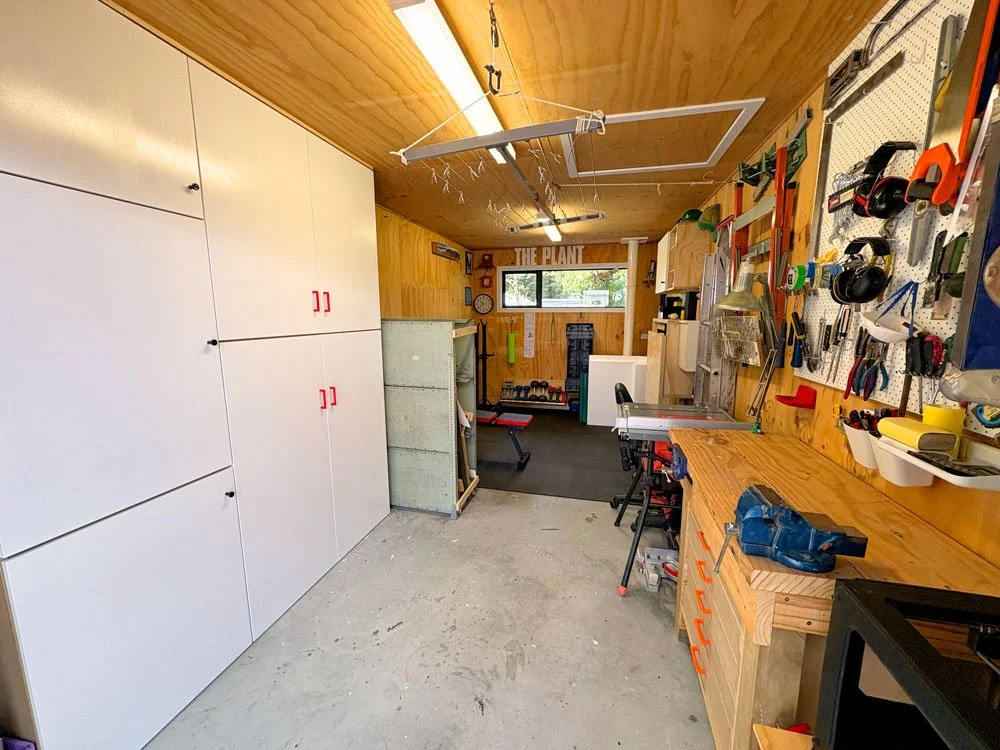
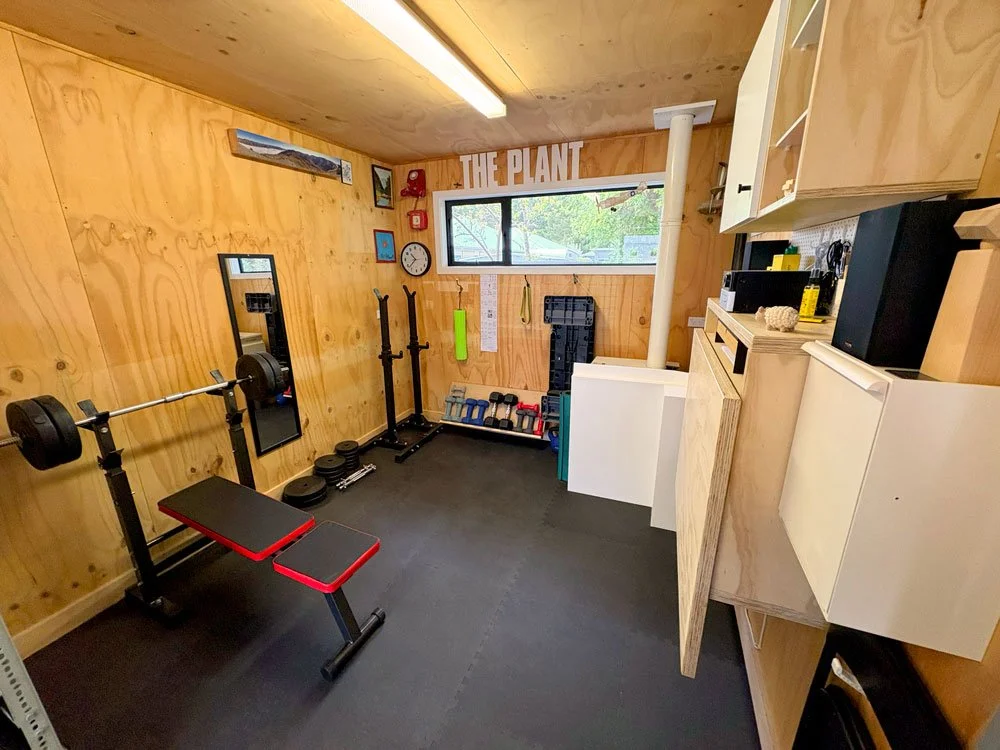
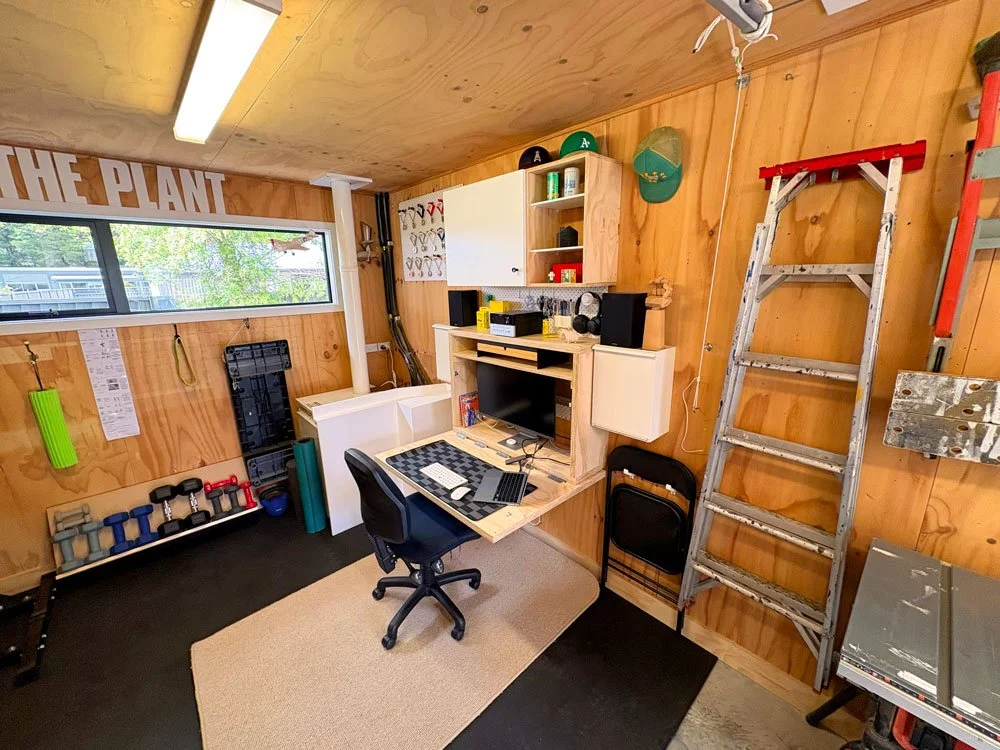
My new office. And gym. And workshop.
I’ve also been spending quite a bit of time in our workshop (which is the size of a single garage). It has had something of a transformation, and much like Ruth, who has her own studio in the garden, this is fast becoming my happy place. Part of it is now a small home gym, and I’ve also managed to squeeze in a new computer workspace.
I built a desk that folds down from the wall, so when I’m not using it, I can fold it away and free up more space for the gym. At the other end of the workshop, I’ve still got my workbench, tools and all the usual workshop stuff. I’ve also built some new shelving and added cupboard doors, which means I can shut the doors and hide everything away. Yes, we could have bought shelving systems from Mega Mitre 10, but I much prefer, and enjoy, building my own.
This has made Ruth very happy. Ruth likes things tidy. I’m a little more relaxed about it. I prefer the term “creative mess”. Apparently, that’s not the same thing as tidy.
Working on The Happy Saver
Another reason I wanted to make work optional was so I could do more to help Ruth with The Happy Saver.
I’ve always been heavily involved behind the scenes. I look after the website, do the design and branding, edit the podcast, and deal with various bits of technology. Ruth has always been the voice of The Happy Saver. She does the writing, podcast interviews, talking, research, answers the many questions people send her, and just generally likes to be helpful.
So, one of our goals when I stopped working was for me to take a bit more off her plate. This post is actually an example of that. I’m a graphic designer, and we’re not exactly known for our writing or English skills, but I’ve really enjoyed using AI as another tool in my arsenal to help me get the thoughts rattling around in my head into something resembling a blog post. Without it, I’m not sure I would ever have thought of myself as someone who could write for The Happy Saver, so it has opened up something completely new for me.
In fact, I’m writing this while Ruth gets on with writing a speech she will be giving in November at KiwiFI. We are very much looking forward to the event, and I’ll be doing something I genuinely am looking forward to: designing her presentation slides. Standing in front of hundreds of people giving a speech is not something she is especially looking forward to. But I know she will be fine.
All that said, now that we can both concentrate on The Happy Saver, we are very much enjoying ourselves!
Earning less also makes me look harder at what we're spending
Leaving my PAYE job and giving up $650 a week of income also made us take a closer look at the costs of running The Happy Saver. I've always been interested in the business side of things because I’ve co-owned a couple of businesses over the years, and I quite enjoy looking at optimising how things operate.
Ruth tracks The Happy Saver’s income and expenses in PocketSmith, much like she does with our personal finances. At the beginning of every month, when we sit down together for our finance meeting, she runs me through our personal finances and then shows me how The Happy Saver is tracking.
One thing that became pretty obvious as we prepared to lose my income was that Mailchimp, which we were using to manage our subscribers and send our fortnightly emails, was costing us ~$2,000 annually, and had become our biggest ongoing business expense.
Even when you think you are paying attention, it is surprisingly easy to tolerate a growing range of expenses. A subscription here. A fee there. Another piece of software that has crept up in price. A new piece of tech. But once my regular pay stopped, I became even more interested in finding out whether we could trim some of The Happy Saver’s ongoing expenses without losing anything we actually needed.
Mailchimp seemed like an obvious place to start.
Following our friends Alan and Katie Donegan's recommendation, I spent many hours researching and testing alternatives before deciding to move all of our subscribers to Kit's free plan. Then came the really nerve-racking bit: sending the first email and crossing my fingers and toes that everything worked.
Thankfully, it did. I don’t think anyone even noticed - which means my research paid off.
For us, $2,000 is a significant saving, and whether for business or personal spending, every ongoing expense you can sensibly reduce is money you no longer have to earn.
As for our personal finances. When I quit my job, we knew we’d be losing about $650 a week in income, so we had already planned for that. We had enough coming in from The Happy Saver to cover our expenses, emergency funds sitting there if we needed them, and we were prepared to sell some shares if it came to that. A few months in, we haven’t had to touch the emergency funds or sell any shares, and at this stage it’s not looking like we’ll need to. So far, the plan is working pretty much as we hoped.
I'm enjoying becoming more involved
Another part of The Happy Saver that I look after is working with the companies that support us. Their advertising helps pay the bills and means Ruth can keep doing what she does.
But something that’s important to both of us is that the companies we work with have no say over what Ruth writes or talks about, and we must genuinely like their products and their people. They’re paying to advertise with The Happy Saver, not paying for Ruth to say nice things about them. There’s a difference, and we’ve always been pretty firm about that.
I also find myself becoming much more involved in the personal finance community. For the past ten years, Ruth has been talking to Kiwis about money. I've always been there in the background, so I've heard plenty of those conversations and been exposed to an enormous range of personal finance stories.
But lately I’ve been meeting and talking to more people in real life, and, slightly strangely for me, enjoying a lot of conversations about personal finance. It still feels a little weird to say that.
Ruth is the talker in our family. I am not. And unlike Ruth, I'm not the person who walks into a room full of strangers and thinks, “Goodie, lots of people I can go and talk to.”
But I’m getting better at it, largely because I realise I’ve got a lot in common with many of the genuinely nice people in the FI community that Ruth is constantly inviting to our house!
Is personal finance a cult?
Every now and then, you'll hear someone jokingly refer to people interested in personal finance or financial independence as part of some sort of cult. Maybe from the outside it can look a little strange. People getting genuinely excited about ETFs and dirt-cheap KiwiSaver fees is probably not everyone's idea of a good night out.
But the more people I meet in this community, the more I see the exact opposite. There isn't one type of person. There isn't one level of income. There are people from all sorts of backgrounds, at all sorts of stages of life, trying to make better decisions with what they have.
Some want to retire early. Some want to get out of debt. Some want to work less. Some just want to worry less about money. People share what they've learned, help each other, and celebrate other people's progress.
It is such a positive community, and nobody I've met thinks they are better than anyone else because of the size of their investment portfolio. It is not really about money. It's about what being better with money lets you do.
So, am I retired?
If by retirement you mean never working or earning another dollar, then no, I'm definitely not retired.
I'm helping Ruth with The Happy Saver. I'm doing the occasional bit of graphic design. I'm building lots of things in my workshop. I'm exercising and continuing with my rehab from my now-infamous fall from the ladder (stay off ladders!). And apparently, I am now the sort of person who has conversations with strangers about ETFs.
But none of those things feel much like “work” in the traditional sense anymore.
I spent more than 30 years arranging large parts of my life around earning an income. That's what you do. You work. You get paid. You take weekends and holidays when you can.
Then, little by little, our finances gave us more options.
I went from working full-time to four days a week, then eventually to two. And now I've gone from having a regular job to having no regular job at all. It wasn't one giant leap from full-time employment to making work optional. It was a slow progression towards needing work less and less.
That's why making work optional still feels like the best description of where I am.
And perhaps that's useful for anyone reading this who likes the idea of financial independence but thinks early retirement sounds completely unrealistic. It doesn't necessarily have to be all or nothing.
Financial independence can look like many forms.
For me, at the moment, it looks like sitting at a desk I had a very enjoyable time building, wondering what day of the week it is.
And I have to say, I'm pretty happy with that.
Happy Saving!
Jonny
Ruth here. As I am editing Jonny’s writing (I reckon that he and AI have done a pretty good job), I can hear the drone of a sander coming from the workshop. So, I can confirm that Jonny is as busy as he has ever been; it's just that he has 100% say in how he uses his time now. Plus, he does the grocery shopping, cooks dinner, does the washing, and is just a generally fabulous husband to be around. Lucky me! And lucky us ❤️