

Applying Rebel Finance School in NZ
02 Aug, 2026
For seven years in a row, I’ve watched the free online money course, Rebel Finance School. For the last couple of years, I’ve joined course creators Alan and Katie Donegan, recipients of the British Empire Medal for services to financial education, for a New Zealand-specific investing session.
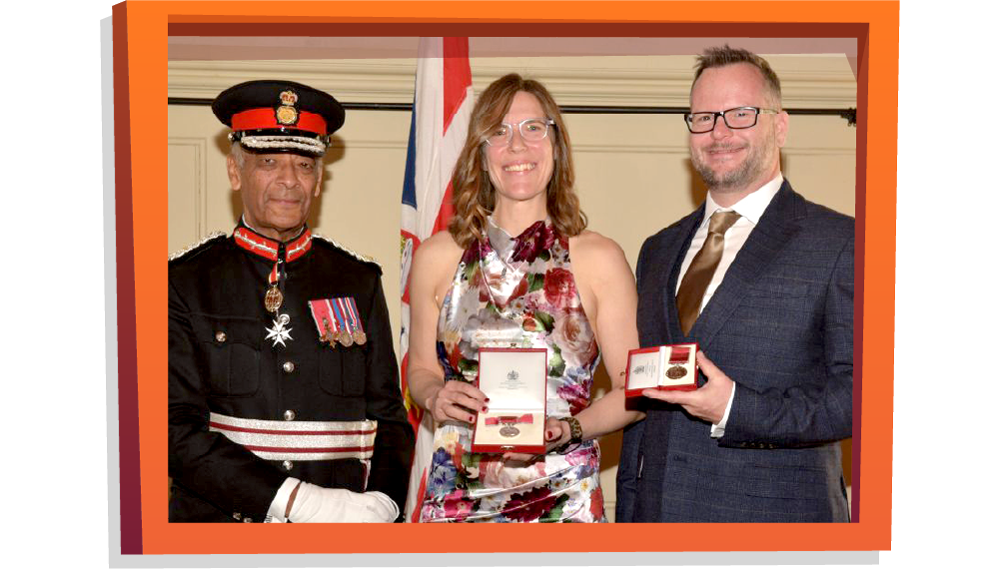
Katie and Alan Donegan with the Lord-Lieutenant of Greater London, after receiving their British Empire Medals for services to financial education in 2025.
The entire 10-week, self-paced course is the money education you never got. I can’t recommend it highly enough.
Just in case you missed the 2026 Kiwi session, here it is: Investing for Kiwis: Platforms, Index Funds & KiwiSavers, RFS 2026 - Week 8
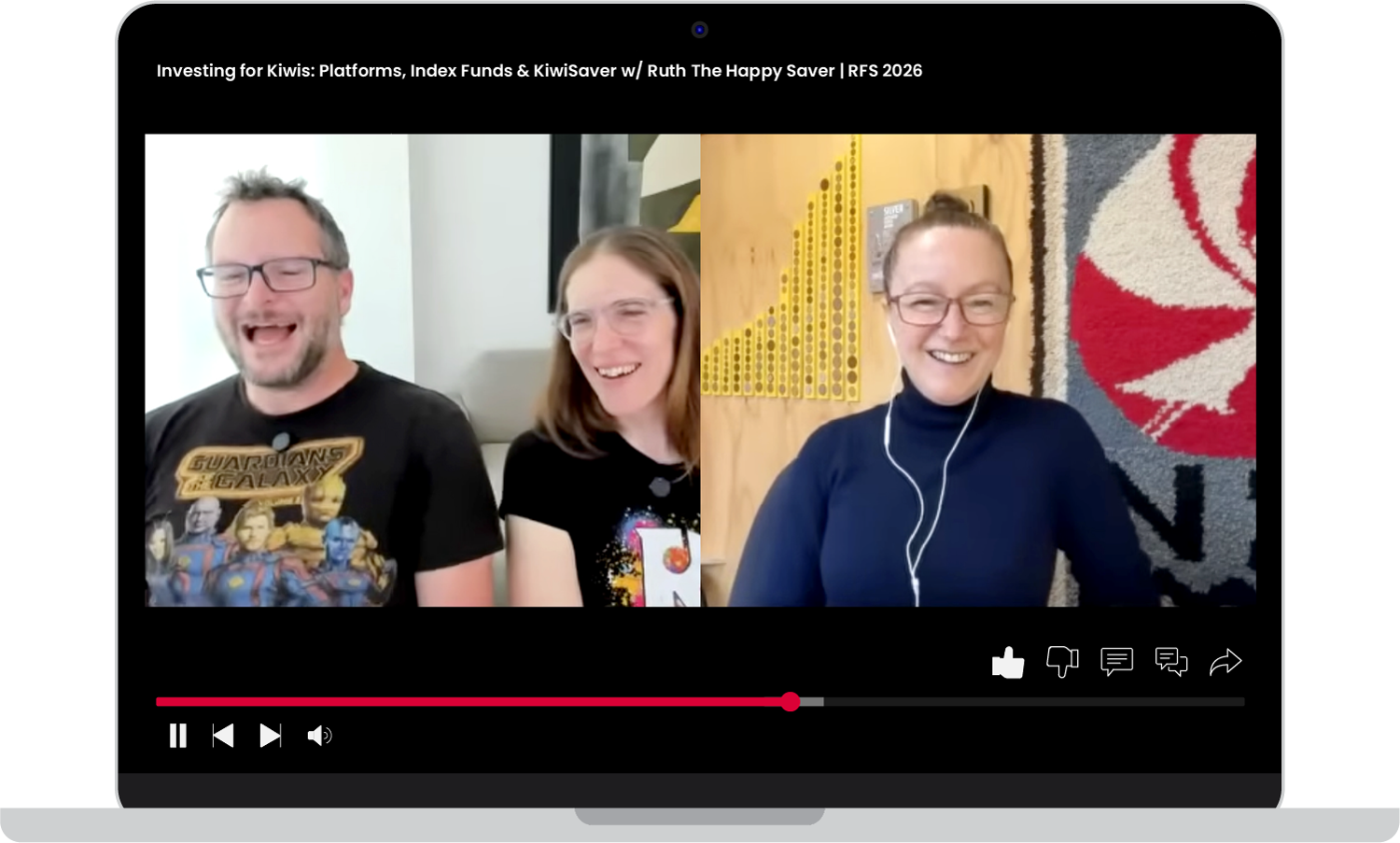
Thousands have already watched that session, but I knew it would be helpful to create a blog that specifically details the investment funds we discussed so that you can locate and research them more easily. Plus, many of you have asked me whether, as a result of new investment options this year and the fee comparison we shared, Jonny and I will make any changes to our portfolio.
For this blog, I’ve assumed that you have attended the seven weeks of Rebel Finance School 2026 that led up to The Happy Saver session in week eight.
So, let’s get straight into it.
What KiwiSaver fund best aligns with Rebel Finance School?
The goal is to just ‘buy the whole world’ with one low-fee, passively managed KiwiSaver fund. Why? Because over time active managers cannot outperform the average of the sharemarket. Check out this SPIVA New Zealand Year-End 2025 report.
We found the cheapest KiwiSaver product we could that simply tracks the massive FTSE Global All Cap Index. All signs pointed us to:
Investnow KiwiSaver Foundation Series Total World Fund
FEES:
This fund has the lowest annual charge in New Zealand of just 0.06%.
Plus a buy/sell transaction fee of 0.50%.
This means that while there is an upfront buy fee of 0.50%, the ongoing annual charge of 0.06% is extremely low once your money is invested. This lower ongoing annual charge means a larger balance over time, despite the buy (and eventual sell) fee.
Although that 0.50% fee looks like it would be a drag on your investment, over time (and KiwiSaver investors are very long-term investors) the math showed otherwise. The low annual charge of 0.06% made it a clear winner.
What should you do with this information? Find your KiwiSaver fund details, and use the Impact of Fees Tool to compare the fees you currently pay for your KiwiSaver fund with the one above. And then use the Sorted Smart Investor tool to compare your KiwiSaver fund performance with the one above.
Paying high fees (anything above 0.50%) and using an actively managed KiwiSaver fund provider does not mean you get a better return. Therefore, do your homework and make a change to your KiwiSaver fund if necessary.
How do I invest outside KiwiSaver?
The next area we covered in Rebel Finance School 2026 was how to invest your ‘gap’, or extra money from your take-home pay, in a similar investment, but one that is not locked away until age 65.
For those wanting to invest in addition to KiwiSaver - perhaps you want to retire early - having share assets that you can use to provide you an income before the age of 65 is crucial. Given we are happy to ‘buy the whole world’ inside a KiwiSaver fund, it makes sense to do the same in an investment outside of KiwiSaver.
Each year on Rebel Finance School, we have tracked down the funds that fit this brief in Aotearoa.
While there are hundreds of investment funds offered in New Zealand, we were able to quickly discount them all, because there were only three that had low fees, were passively managed, and tracked the FTSE Global All Cap Index:
FEES:
While they essentially sell the same thing, Investnow, Kernel and Smart are three entirely different companies, with their own unique twist on investment as a business, meaning that each company charges different fees:
| Provider | OCF (ongoing charge fee) | Buy Fee | Sell Fee | Annual Plan |
|---|---|---|---|---|
| InvestNow | 0.06% | 0.50% | 0.50% | Nil |
| Kernel | 0.12% | Nil | Nil | $50 |
| Smart | 0.40% | Nil | ~0.30% | Nil |
Katie, the mathematician behind Rebel Finance School, took the time to compare all three, and you can use her calculators yourself to make your own comparisons.
“BUILD IT” phase of your fund:
We spend decades building our investment fund. Below is an example of the performance of the three providers in the 10, 15, and 20-year ‘build it’ phase, including relevant fees. In the short term, the differences are smaller, but the gap widens over time as higher fees are taken from your fund, reducing the compounding of the money left invested.
Remember, too, when you read this graph, that we are comparing the three low-fee providers in this market. And if the difference in returns over time between these three is meaningful, imagine if I had added a provider with a commonly seen fee of around 1.5% +/-. The difference in value would have been even greater. You should run your own math, using your fund manager's fees.
“LIVE FROM IT” phase of your fund:
For this section, RFS focused on what happens after the 10-20 years of growing your fund, focusing on the 5-20 years that come after, when you are actually selling off a monthly amount, allowing you to fund your retirement. They took the sell fees into account, and the first section, “Financial Freedom”, is the day you retire.
I asked Katie to run some math for me, and as you will see from both graphs, in both the build-it and use-it phases, the shorter the term, the smaller the difference between funds, but in the longer term, the gap widens. A higher fee compounds against the fund returns over time. Fees matter.
So, given there are so many companies in New Zealand, in addition to these three, selling thousands of investment products, why don't they all just lower their fees? Well, they're running businesses. They have staff to pay, systems to maintain, shareholders to keep happy, and, like any business, they'll generally charge as much as the market will bear.
But investment companies also operate in a competitive market. None of them wants to lose customers to a rival. If investors decide a company's fees are too high for what they're getting in return, they can simply take their money elsewhere. That competitive pressure encourages investment providers to keep fees as low as possible while still running a profitable business.
Every person is in a different financial situation
Now, of course, the numbers Katie has used in the graphs above are just assumptions, and everyone is at a different age and stage of life. They tried to give a clear explanation to help you understand the concept.
The issue we all have is that investment providers and the funds they offer are constantly evolving, making it very challenging to compare like with like. While the three providers above have different fee structures, comparing them was relatively straightforward. But if you are with an actively managed provider or are using a Financial Advisor, your exact fees will be much more opaque. There will be several layers of fees and different charges for different things. But with enough digging and enough questions, you will be able to work it out. Use the RFS Tools to help you do this.
What should you do with this information?
Make the best decision you can, with the information you have, and review it annually.
We compared New Zealand’s three low-fee providers, all good businesses selling essentially the same thing, and you can see the impact that fees have over time. But here in New Zealand, I would hazard a guess that most people who don’t follow The Happy Saver or RFS have not heard of a Total World Fund, nor the providers InvestNow, Kernel, or Smart, and those people are in actively managed, high-fee funds.
When you compare those more expensive funds with any of the three funds mentioned, the gap will be even wider. Some people have shared some eyewatering high numbers since we ran the session. I love that you have done your own research.
So, again, find out what you are invested in, and use the Impact of Fees Tool to compare the fees you currently pay for your investment fund with those above. And then use the Sorted Smart Investor tool to compare your investment fund performance with the ones above.
What is my investment story?
As soon as the session ended, I expected a few emails, and you didn’t disappoint.
Since the RFS Kiwi session, many people have essentially asked me the same question:
"Ruth, I know you use the InvestNow Foundation Series Total World Fund in KiwiSaver and the Smart Total World Fund outside KiwiSaver. Given that Kernel's fees are lower than Smart's, and InvestNow's are lower still, are you going to change?"
To answer that question, I had to dig much deeper into our own investment history.
Having joined KiwiSaver in 2007, we've changed providers a few times. We started with ANZ, moved to Simplicity, and are now with InvestNow. To give some context, I wrote this blog post: Why I Changed KiwiSaver Providers. Over the past 19 years, as I learned more about investing and as new KiwiSaver funds became available, we changed.
The KiwiSaver funds available in 2007 are very different from what is on offer today. The industry evolved, and so did we. And I expect we'll continue to evolve.
Alongside KiwiSaver, Jonny and I have invested outside KiwiSaver for many years. When JL Collins, author of The Simple Path to Wealth, first introduced me to ETFs and index funds, I went looking for New Zealand providers. At the time, only two places were offering low-fee passive index investing: Smart and InvestNow.
There was no Kernel, Hatch, Tiger Brokers, Sharesies, or any other low-fee ETF/Index fund provider you may know of today.
Back then, without today's comparison tools and mathematical friends like Katie helping me work through the numbers, comparing providers was hard yakka. Regarding our original ANZ KiwiSaver, I distinctly remember phoning them up about their fees, and they said, “We don’t have to disclose that information”. We have come a very long way! There just wasn't the same focus on fees that there is today. Smart and InvestNow had very different fee structures, plus, then as now, I found the InvestNow website difficult to navigate.
So how did I choose?

It actually came down to something quite simple.
Before 2015, we had briefly worked with a financial adviser who had signed me up to a Smart investment (and charged me an additional fee to do so, I might add), so I was already vaguely aware of the name. As I researched further, I learned that Smart had been around for ~20 years and was owned by NZX, which I trusted. But I'd never heard of InvestNow, which had only launched in 2017.
After a lot of digging, I felt I'd found two good options. But Smart felt established, while InvestNow was the new kid on the block.
So I chose Smart.
Looking back through my records, it's clear I didn't simply discover the Smart Total World Fund and happily invest ever after.
Far from it. That fund didn’t exist.
My first Smart investment was actually the NZ Top 50 ETF, something I wouldn't buy today. Before that, we'd been investing in all sorts of things: Bonus Bonds, Meridian Energy shares, OneAnswer funds, term deposits, and even gold. None of those is investments I'd choose today.
It wasn't until we read JL Collins that we began investing seriously in the Smart US 500 ETF, and over the years it has delivered fantastic growth. His famous advice to buy “VTSAX and chill” really resonated with me.
Even then, though, I was still tinkering. We owned individual shares, such as Ryman Healthcare, bought some Bitcoin, and even invested in a property ETF. Again, none of those is investments I'd choose today.
As new providers launched, we experimented there too. We opened accounts with Hatch (2019), Sharesies (2019) and later Kernel (2020). But as our knowledge grew, we realised we needed to simplify, and over time we steadily sold those smaller investments and consolidated everything into what became our long-term strategy.
Eventually we arrived where we are today.
Regular readers of The Happy Saver will know we switched from the Smart US 500 ETF to the Smart Total World ETF in 2025, and moved our KiwiSaver to the InvestNow Foundation Series Total World Fund in late 2024. FYI, we also continue to buy the Smart Total World Fund through Sharesies because we have an affiliate relationship with them.
All of which is to say: Investing is an ever-evolving process.
The InvestNow Foundation Series Total World Fund didn't launch until 2022.
The Kernel Total World Fund only launched in mid 2026 (three weeks before the Kiwi RFS session).
So I don't look at the fee comparisons from Rebel Finance School and think:
“Crikey, what have I done! I've spent ten years in Smart when I should have been investing in InvestNow or Kernel all along.”
Because I couldn't have; those funds simply didn't exist. So when asked if I will sell up and move, I say, “Context matters”. But am I taking notice? Absolutely.
When you look back over your own investment journey, you'll probably find exactly the same thing. Through today's lens, your earlier decisions may no longer look optimal. But based on what you knew, and what was available at the time, they were probably perfectly reasonable decisions.
So, after seeing these latest numbers, are we going to sell everything and move? No.
If Smart doesn't lower its fees, would we consider moving in the future? Maybe. I will continue to monitor it, and I’ve actually set the recently retired Jonny the task of becoming a Sharesight expert user, so both of us can play an active role in any decision to stay/move, using our actual correct data.
Our hesitation also comes from another important reason we are happy to continue investing with Smart for now: ownership.
When we buy the Smart Total World ETF directly, our units are held on an independent share registry (MUFG) in our own names under our own Common Shareholder Number (CSN). We are the legal owners of those units, and we own them independently from Smart. If we ever decide to sell, we can choose whichever online share broker we want to use, aka, the cheapest.
With InvestNow and Kernel, your investments are held in custody on your behalf. There is nothing wrong with that model; it works for them and their investors. But for us, direct ownership is important. It's simply a personal preference that gives us an extra sense of control.
Why? It probably stems from an experience unrelated to investing.
After the Canterbury earthquakes, our house, which we owned without debt, was compulsorily acquired (a decision we were happy with because it meant we could leave). Although we were entitled to our money, it took two to three years before everything was resolved and we were paid out. Ever since then, I've had a strong preference for owning assets directly wherever I reasonably can.
I want to be clear that I'm not suggesting there is anything wrong with the custody model used by InvestNow or Kernel. Client investments are held separately from the businesses themselves, and there are protections in place. But if a platform ever ran into difficulties, there could be an administrative process before investors regained access to their investments. Personally, I'd rather avoid that possibility by holding our ETF directly in our own names. For us, it is peace of mind.
To end, I don't spend much time in personal finance Facebook groups. Keeping up with my email inbox is enough! But one thing I do notice is that discussions often become very black-and-white. People tend to think there is one perfect answer.
My experience has been the opposite.
Personal finance is messy, it's personal, and it's constantly evolving. And sharing my journey as I have for ten years now shows that.
We all make the best decisions we can with the information available to us at the time. Then we review.
I'll keep sharing what Jonny and I are doing, not because I think our way is perfect but because I hope it helps you think more deeply about your own decisions. Focus on your own money, do your own numbers, and keep making the decisions that feel right for you.