

SpaceX IPO? Remember That?
05 Jul, 2026
I know that by now the fuss over the mid June 2026 SpaceX IPO (Initial Public Offering) has died down, but that is exactly why I waited a few weeks to write about it.
I wanted to bring to your attention that, despite *insert current events feed of your choice* screaming a blow-by-blow account of the SpaceX IPO, that didn’t mean you had to react. Like, not even a little bit.
But many did, and they scared themselves silly as a result. Successful investing is mostly about ignoring the noise, but sometimes that is easier said than done.
Now that it's well out of the headlines, and so that you can recognise a storm in a teacup next time one appears, I want to dig into what happens to your ETF or Index Fund once the fuss dies down. You actually become a part owner of a company that has chosen to list on a stock exchange.
Hint: almost nothing changes.
The SpaceX IPO in June 2026 received extensive coverage. With a valuation in the trillions, it immediately became one of the world's most talked-about companies, and I asked myself the question:
When will SpaceX be added to the Smart Total World ETF (TWF) we own?
Many others asked me the same question, so I did my research and emailed Smart directly to understand how the process works from their perspective. Tip: Never hesitate to contact your provider directly if you have questions.
Here goes my shot at a useful explanation.
The Smart TWF tracks the FTSE Global All Cap Index, one of the broadest sharemarket benchmarks worldwide. Rather than you and I having to select and buy individual companies, the fund seeks to provide exposure to virtually the entire investable global sharemarket. For SpaceX to become part of my TWF, it first had to become part of the FTSE Global All Cap Index.
A quick explainer: FTSE stands for Financial Times Stock Exchange, the organisation responsible for creating and maintaining the index. Global means companies from around the world. All Cap (capitalisation) means companies of all sizes. An index is a list of companies used to measure the sharemarket.
Historically, newly listed companies have often had to wait until a scheduled index review (when companies join, stay in, or get kicked out of the index) before being added to major benchmarks. However, index providers have increasingly recognised that some IPOs are simply too large to ignore. If a company is large enough and meets the index rules, long-term ETF investors want it included because the goal is to own the whole market. SpaceX is one of those companies - too big to ignore. In recent years, FTSE Russell has introduced fast-entry rules that allow exceptionally large newly listed companies to enter its indexes much sooner than the traditional review schedule.
Given SpaceX's large size, FTSE added Space Exploration Technologies Corp (SpaceX) to the FTSE Global All Cap Index on 22 June 2026.
At what point do I actually own SpaceX?
Now that SpaceX had been added to the FTSE Global All Cap Index, I wanted to know how quickly that would flow through to my Total World Fund ETF. When would I own it? There is usually a short delay between a company being announced for inclusion and its actual entry into the index. This gives fund managers time to execute trades, align their exposure and avoid tracking differences.
But basically, as soon as the index includes the stock, any fund tracking that index is expected to have exposure to it shortly afterwards. So, the inclusion of SpaceX in my Smart TWF happened very quickly.
Given that SpaceX is massive, does that mean it takes up a disproportionate chunk of the TWF?
Although SpaceX is worth trillions, only a small proportion (about 4-5%) of the company was actually listed on the sharemarket. The rest remains in private hands. Index providers only include the shares available for investors to buy, not the entire company. As a result, SpaceX entered the index at about 0.07%, limiting its weighting in my TWF.
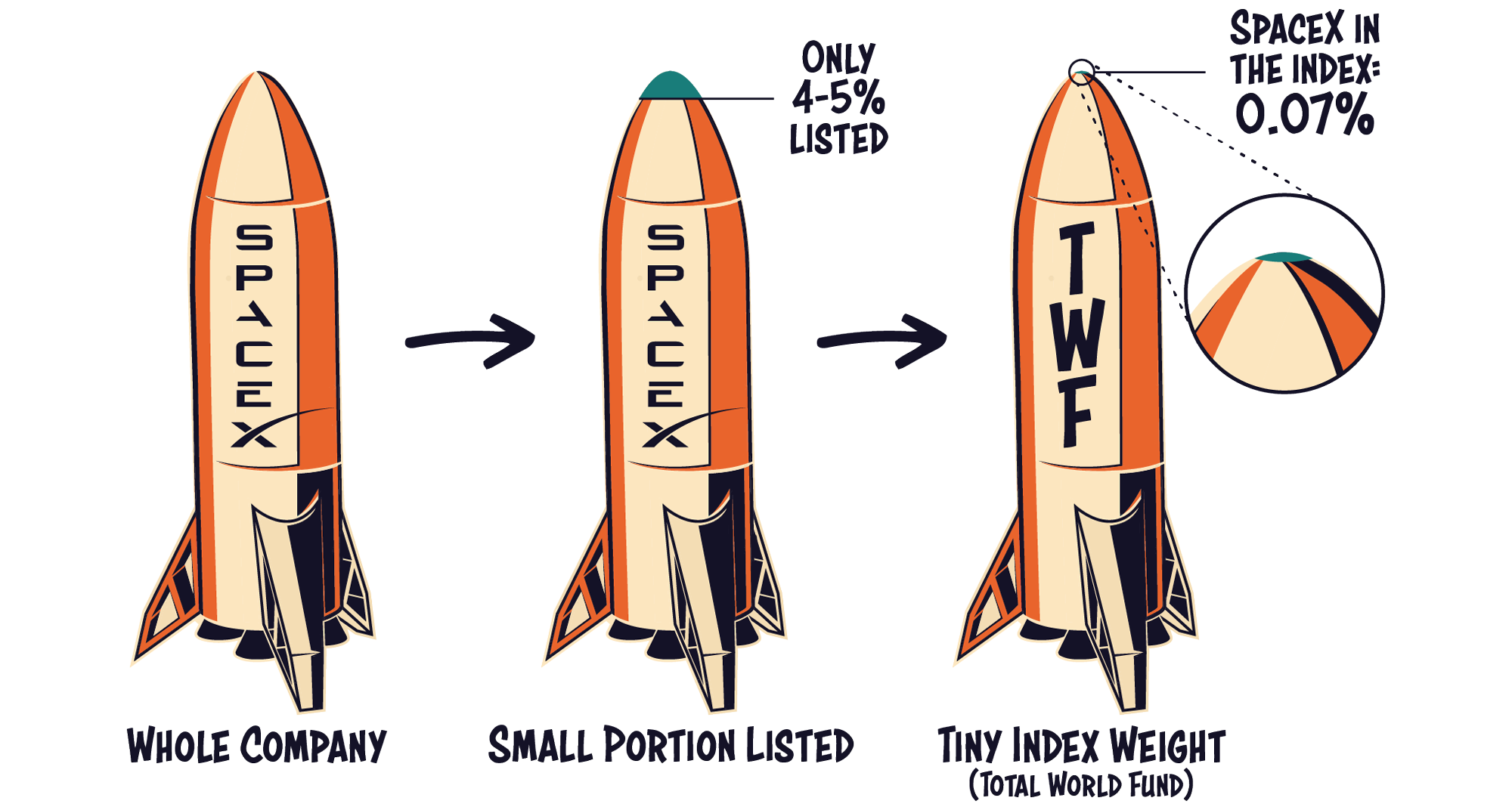
So, for all the bother and frenzy about how much this IPO might skew sharemarkets, when all was said and done, SpaceX made up a very small part of the Global Index.
There is logic behind the composition of an ETF.
I wanted to write about it because I saw this as a great opportunity to explain that an ETF is not some kind of "magic"; there is reasoning behind its composition.
The hype around this IPO might have you believe that adding a new company to an index is a one-off. It isn't. Throughout the year, as part of their normal business, companies are added and removed. The difference is that the company in question usually isn't as large, or as hyped, so you don't hear about it.
As at the end of May 2026, there were 10,137 companies in the FTSE Global All Cap Index, and therefore in my Total World ETF.
This is the beauty of the simplicity of ETF investing. With one purchase, I spread my investment dollar across more than 10,000 companies, meaning I am incredibly diversified, yet I don’t have to manage the fund's makeup myself. Thank goodness.
In general, the FTSE Global All Cap Index is reviewed quarterly, on the third Friday of March, June, September and December. At that time, providers (in my case, Smart) add or remove companies from the ETF to match the index as closely as possible.
We never hear about the other companies that come and go; it's just that this particular IPO drew a lot of media attention.
But out of interest, during the June 2026 rebalance, at least six new Indian companies were added to the FTSE Global All Cap Index: Lenskart, Groww, Tata Capital, LG Electronics India, Meesho, ICICI Prudential Asset Management.
There were also multiple companies removed from the index, and therefore from the ETFs tracking it. Did you hear about any of those companies? Neither did I. Yet they quietly became part of my ETF investment, and that is how index investing works.
Businesses are quietly added, removed and reweighted every year. SpaceX only felt different because the media couldn't stop talking about it.
Companies are working to make me rich.
I know that sounds crass to say, but it is true.
The entire point of companies, and the sharemarkets they list on, is that they are each doing their level best to grow and be profitable by providing products and services the world is asking for. In the words of JL Collins, each of the companies within my fund “are working to make me rich.”
If you want to do a deep dive into what countries and companies are actually in this index, you can start your search with the FTSE Global Equity Index Series. Hint: Look at it for FUN, not because you need to study it to invest well.
Now that SpaceX is listed on the sharemarket - or at least a small portion of it is - investors get to decide what it's worth. Just like every other company (all 10,137 of them), it's up to them to offer products and services that people want. If buyers want what they're selling, the share price will go up. If they don't, it will go down.
This is exactly why I don't spend my days chasing the next big thing. Because no one really knows who is coming, and who is going. Before SpaceX, we were in the grip of Nvidia. Before Nvidia, it was something else. Remember Meme stocks? What about NFTs? Some do well, some flatline.
There will always be another company everyone thinks you simply must own. But if you own a global index fund, chances are you'll own it eventually anyway.
The next time a company dominates the headlines, remember SpaceX and the urgency that was created around the event. And remember that your job as a long-term investor is almost the opposite: Chill out. Keep buying. Don't be in a hurry. Stay invested.
“This time” is probably not different to any other time, and you are best to ignore the hype and let your ETF quietly do its job.
That's exactly what mine did, and continues to do. Over time, the sharemarket goes up, and the simplest thing I can do as an investor is just buy the whole lot.