

Buckle up - here we go again!
29 Mar, 2026
This week, I wanted to go back in time, six years back to March 15, 2020, when the world was in turmoil.
Again.
At that time, I wanted to address your concerns about the global crises, particularly around COVID. I took the time to write a blog post about it, and today, I’ve summarised the key points and added an update at the bottom. Because, surprise, surprise, here we go again, folks!
This is what I wrote:
March 15, 2020
I had a coffee with a friend last week. We catch up every couple of months and talk about money - everything and anything - and given global events were brewing, I was interested in his perspective.
A few days later, I turned on RNZ. In hindsight, not my best decision. The headlines on March 10th were relentless:
Russia and Saudi Arabia arguing over oil prices
Coronavirus panic spreading
The US share market having its worst day since 2008
It all sounded alarming. And as the week went on, nothing seemed to improve. My overriding thought was: What can I possibly do about any of this?
It reminded me of something my friend had said. Years ago, you’d read in the newspaper that the US sharemarket had dropped - maybe the biggest fall in years - and by the time you read it, it had already happened. There was nothing you could do - no chance to react. You just had to carry on.
But not today. Now we are in the thick of every tiny thought or decision made by world leaders, governments, and industries - all in real time - and it feels like it’s all screaming at us as share investors to DO SOMETHING.
And if we actually did something, then minute by minute we would be adjusting our portfolios.
It’s too much. It’s simply impossible to keep up with all the suggestions of how we should act!
But when I stop and think about my own life, what’s actually within my control, everything feels a lot calmer.
Yes, big things are happening in the world*. But what am I realistically expected to do about oil disputes or global travel bans due to a pandemic? Beyond basic precautions and looking after the people around me, not much.
*As you read this, remember, I am still talking about 2020 events here.
So instead, I focus on what I can control, and I refuse to panic.
Because, to put it bluntly, stuff has always been happening somewhere in the world. The difference now, in 2020, is that we hear about all of it, instantly and incessantly. And once this round of drama passes, something else will take its place.
It always does.
Bringing it back to money, Jonny and I are sticking to the basics to steer our waka through these rough waters:
No debt
A rainy day fund
Multiple income streams
Minimal expenses and intentional budgeting
Ongoing investment, regardless of what the share market is doing
Kindness. Look after others
The Christchurch earthquakes that kicked off in 2010 taught us a lot that is relevant today, especially how much is outside our control. But we also learned that having a solid financial foundation and supporting those around us creates resilience when things feel uncertain. Putting those basics in place has made us stronger with each passing year.
2020 was the first significant share market dip I’d personally experienced, but I’d read enough to know the right approach: hold our course and hold our nerve.
If you’ve been caught off guard by Covid, take it as a lesson. There will always be a next time. Get ready.
Because the share market reacting to world events is nothing new. It’s simply people buying and selling based on what they think will happen next.
And over time, despite wars, crises, and uncertainty, the share market has always trended upward.
So we position ourselves to hold on for the ride.
I continued investing, while also making sure we still had enough cash for everyday life and that our emergency fund remained untouched.
I didn’t see it as a time to sell. If anything, it was a time to buy - shares were on sale.
This period will pass. And in time, the market will continue its upward climb.
Six Years On… (2026 Update)
Reading that back now, it really does feel like… here we go again! It all sounds familiar, right?
Did the share market continue its climb? You bet!
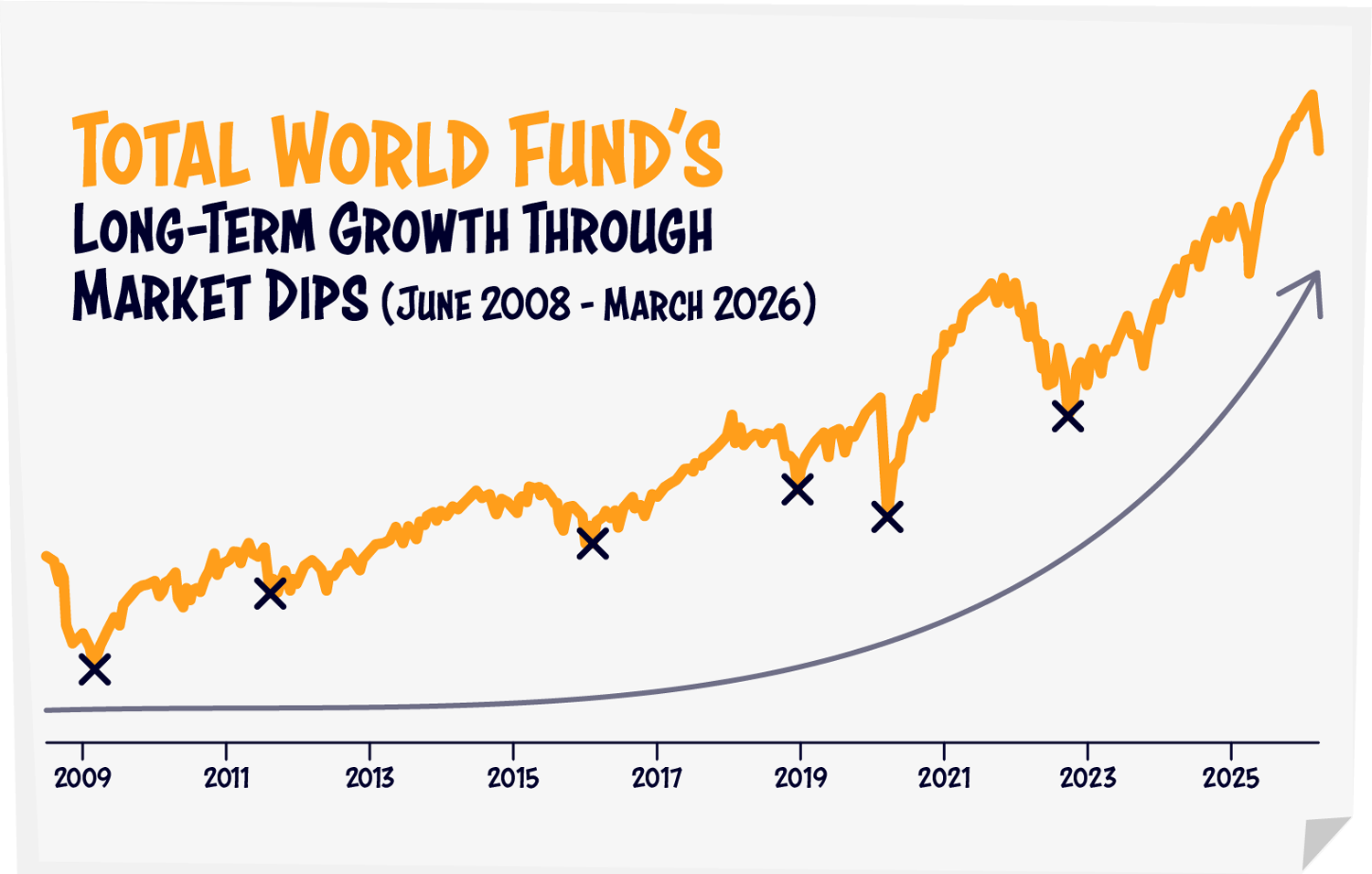
This chart shows how the fund has continued to grow over time, even with periods of market volatility and short-term declines along the way.
Source: Google - Vanguard Total World Stock Index Fund ETF
Currently, we have different headlines, but they have the same feeling of urgency.
Back then, it was Covid, oil shocks, and share market panic. Today, in 2026, it’s war, rising petrol prices, and global supply chain uncertainty dominating the news cycle. Oh, and let’s not forget the threat of WWIII.
I rang my friend again in March 2026 and asked if anything had changed, given what’s happening in the world right now. He said nothing different. We don’t know how long this will last, and no one can predict that. But like every event before it, the world will get through it. Share markets will recover - we don’t know when, but they will. For most people with a long investment horizon, this is just another bump in the road. There’s always something, and this is just one more thing to add to a very long list.
Six years on, Jonny and I are still doing exactly the same thing.
No debt
A rainy day fund
Multiple income streams
Minimal expenses and intentional budgeting
Ongoing investment, regardless of what the market is doing
Kindness. Look after others
If anything, we’ve simplified our investing even further. The change is that we now invest entirely in a Total World ETF (Smart) - both inside KiwiSaver (using InvestNow) and outside of it. One massive fund, globally diversified across ~10,000 companies. As with 2020, some companies will rise to this challenge, and some will go broke, but due to the fund being ‘self-clensing’, without having to buy/sell/manage anything, we will always own the biggest and best.
We still consistently invest as much as we can every single month. No changes. No reacting. No second-guessing.
Our consistent approach has been rewarded, as share markets have continued to rise over the past six years. Not in a straight line (there have been dips and peaks), but the overall direction has been up.
Which is why the current global situation, as serious as it is, is also just another moment, bump or blip in time for the share market.
Meanwhile, in our day-to-day lives?
Petrol prices go up. Groceries get more expensive. We adjust to these challenges as best we can. I have not even looked at our investment balance during the month because there is no point in doing so.
The news feels dramatic, but financially, while it’s an annoyance, it's thankfully not a crisis, and we continue to control what is in our realm to do so.
And that’s really the point.
No matter where you are on your financial journey, the goal is to continue to systematically build a life week by week, month by month, and year by year, where these kinds of events don’t knock you off your financial course. Where you’ve got your systems in place - your savings, your investing, your plan - so that when the world gets crazy, you don’t have to react to it.
So when it all feels a bit overwhelming, remember, this is just another round. And I’m sorry to say, in six years, something else will be happening. It never stops.
Which is why we don’t panic. The best action is actually inaction. We just keep going.
Big world events can make markets feel scary in the moment, but this table shows how share markets have historically performed in the months after major geopolitical and historical shocks, a helpful reminder that short-term volatility is normal, and markets recover over time.
Click to view historical market performance table
| S&P 500 Index Returns | |||||
|---|---|---|---|---|---|
| Market Shock Events | Event Date | 1 Month | 3 Months | 6 Months | 12 Months |
| Germany Invades France | 5/10/1940 | (19.9%) | (12.7%) | (4.5%) | (18.7%) |
| Pearl Harbor Attack | 12/7/1941 | (1.0%) | (11.0%) | (6.5%) | 4.3% |
| N. Korean Invades S. Korea | 6/25/1950 | (10.0%) | 1.6% | 4.1% | 11.7% |
| Hungarian Uprising | 10/23/1956 | (2.1%) | (2.8%) | (1.3%) | (11.7%) |
| Suez Crisis | 10/29/1956 | (4.4%) | (3.6%) | (0.0%) | (11.6%) |
| Cuban Missile Crisis | 10/16/1962 | 5.1% | 14.1% | 20.7% | 27.8% |
| Kennedy Assassination | 11/22/1963 | 6.8% | 11.9% | 15.5% | 23.2% |
| Gulf of Tonkin Incident | 8/2/1964 | (1.6%) | 1.9% | 5.3% | 2.7% |
| Six-Day War | 6/5/1967 | 3.3% | 5.9% | 7.5% | 13.5% |
| Tet Offensive | 1/30/1968 | (3.8%) | 5.1% | 5.2% | 10.2% |
| Penn Central Bankruptcy | 6/21/1970 | (0.1%) | 7.2% | 16.8% | 28.6% |
| Munich Olympics | 9/5/1972 | (1.0%) | 5.7% | 2.3% | (5.8%) |
| Yom Kippur War | 10/6/1973 | (3.9%) | (10.7%) | (15.3%) | (43.2%) |
| Oil Embargo | 10/16/1973 | (7.0%) | (13.2%) | (14.4%) | (35.2%) |
| Nixon Resigns | 8/9/1974 | (14.4%) | (7.0%) | (2.8%) | 6.4% |
| Reagan Shooting | 3/30/1981 | (0.9%) | (1.8%) | (14.0%) | (16.4%) |
| Continental Illinois Bailout | 5/9/1984 | (3.1%) | 1.0% | 6.4% | 12.8% |
| 1987 Stock Market Crash | 10/19/1987 | 8.1% | 10.9% | 14.7% | 22.9% |
| Iraq's Invasion of Kuwait | 8/2/1990 | (8.2%) | (13.5%) | (2.1%) | 10.1% |
| Soros Breaks Bank of England | 9/16/1992 | (2.5%) | 3.0% | 6.8% | 9.9% |
| First World Trade Center Bombing | 2/26/1993 | 1.7% | 2.0% | 4.0% | 4.7% |
| Asian Financial Crisis | 10/8/1997 | (3.7%) | (1.8%) | 14.1% | (1.5%) |
| U.S.S. Cole Yemen Bombing | 10/12/2000 | 2.7% | (0.9%) | (11.3%) | (19.6%) |
| U.S. Terrorist Attacks | 9/11/2001 | (0.2%) | 2.5% | 6.7% | (18.4%) |
| Iraq war started | 3/20/2003 | 1.9% | 13.6% | 18.7% | 26.7% |
| Madrid Bombing | 3/11/2004 | 3.5% | 2.7% | 1.5% | 8.4% |
| London Subway Bombing | 7/5/2005 | 3.3% | 1.8% | 5.3% | 5.5% |
| Bear Stearns Collapses | 3/14/2008 | 3.6% | 5.6% | (2.8%) | (41.5%) |
| Lehman Brothers Collapses | 9/15/2008 | (16.3%) | (26.2%) | (34.8%) | (11.7%) |
| Boston Marathon Bombing | 4/15/2013 | 6.3% | 8.4% | 9.7% | 17.9% |
| Russia annexed Crimea | 2/20/2014 | 1.5% | 2.6% | 8.0% | 14.7% |
| BREXIT | 6/24/2016 | 6.5% | 6.2% | 11.0% | 19.7% |
| Bombing of Syria | 4/7/2017 | 1.8% | 3.1% | 7.6% | 12.8% |
| North Korea Missile Crisis | 7/28/2017 | (1.1%) | 3.6% | 14.8% | 13.4% |
| Saudi Aramco Drone Strike | 9/14/2019 | (1.4%) | 5.4% | (8.8%) | 12.5% |
| Iranian General Killed In Airstrike | 1/3/2020 | 1.9% | (23.1%) | (4.2%) | 14.4% |
| U.S. Pulls Out of Afghanistan | 8/30/2021 | (3.7%) | 2.8% | (4.9%) | (12.0%) |
| Russia invades Ukraine | 2/24/2022 | 5.9% | (7.2%) | (2.1%) | (7.1%) |
| Hamas attacks Israel | 10/7/2023 | 1.3% | 10.6% | 20.9% | 33.5% |
| Iran attacks Israel | 4/13/2024 | 1.9% | 9.9% | 13.5% | 5.3% |
| Liberation Day | 4/2/2025 | (0.5%) | 10.6% | 19.1% | ? |
| US Bombs Nuclear Facilities In Iran | 6/22/2025 | 5.7% | 11.7% | 13.5% | ? |
| US Removes Maduro in Venezuela | 1/3/2026 | 0.9% | ? | ? | ? |
| Average | (0.9%) | 0.8% | 3.4% | 3.0% | |
| Median | (0.2%) | 2.7% | 5.3% | 7.4% | |
| % Higher | 46.5% | 66.7% | 61.9% | 65.0% | |