Someone Call an Ambulance
15 Mar, 2026
We’ve had a bit of drama recently, meaning all of our 2026 plans are currently up in the air.
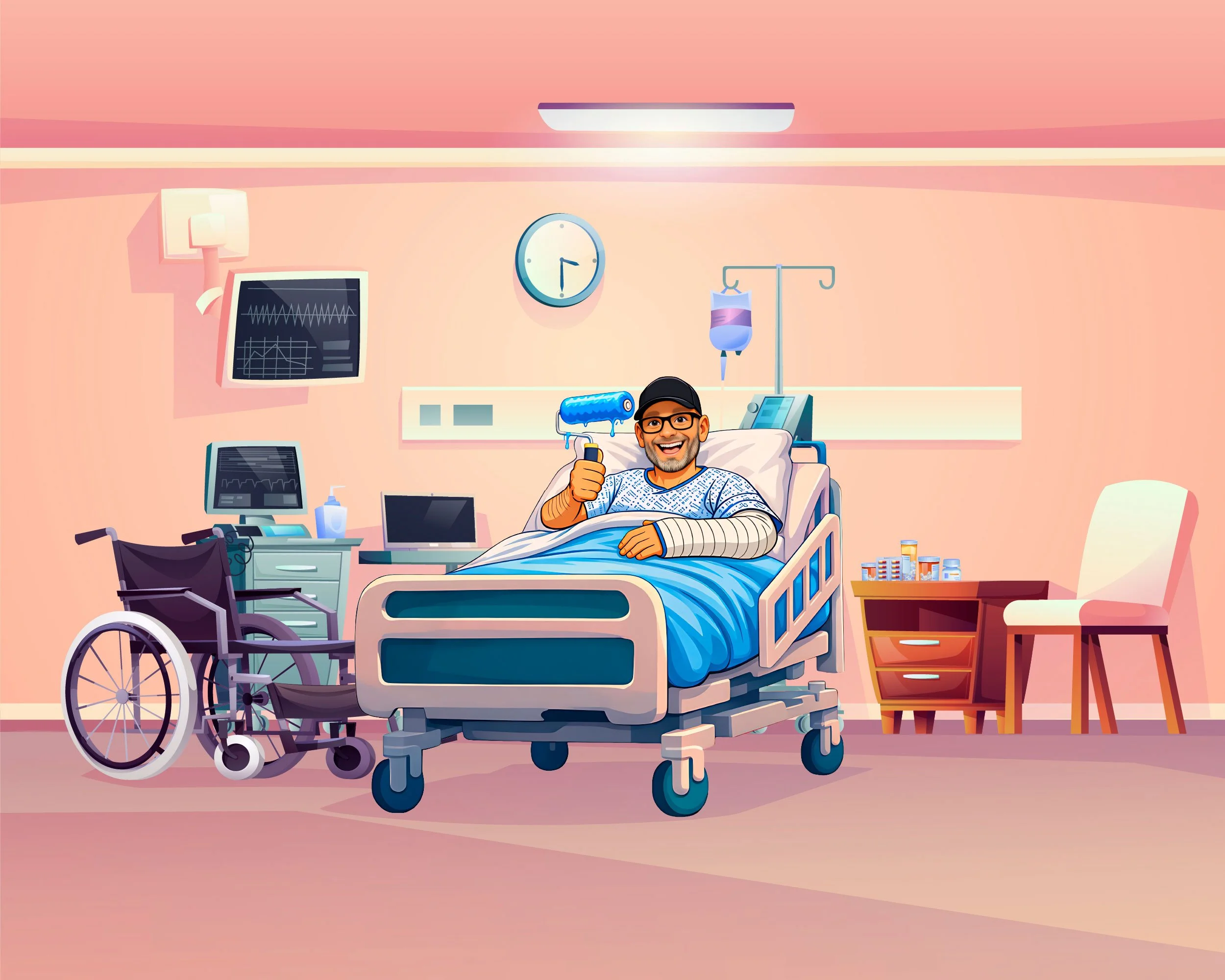
Jonny had a serious accident; he fell off the ladder, broke his arm, fractured his pelvis in four painful places, and after eight days in hospital, has returned home to rest and recuperate. We’ve had to rejig our planned 2026 because, while he will fully recover, we don’t know how long that recovery will take.
Sometimes life throws you a curveball that, while you are in amongst it, you can’t see your way out, and while we don’t exactly know how this will all medically shake out, we do have a firm financial grip on the financial side of life.
He had been in the hospital for many days when he turned to me and said:
“Well, at least money is the last thing I need to worry about. In fact, it hadn’t even crossed my mind.”
I am very aware that a comment like that is such a luxury.
One of the things I often talk about here on The Happy Saver is building financial resilience so that when life throws something unexpected your way, money doesn’t become an additional stress. Not having to worry about money at a time like this has taken years of work, and this is a real, pinch-me moment where current-day Ruth and Jonny are extremely grateful to past Ruth and Jonny for taking a portion of every single paycheque and investing it for the future.
Jonny’s experience over the last week and a half has been a very real reminder of why that matters.
Given that Jonny’s job at the hospital was to stay in bed and rest, I suggested he write some notes about his/our current situation. And he did. A strange writing debut, but nothing encourages you to try something new, like a near-death experience.
I’ll let Jonny go for it, and I’ll add some thoughts at the end.
Ruth
What Goes Up Must Come Down
Ruth and I have been discussing downsizing the house to free up capital to invest in our Smart Total World Fund. Doing so would push us into full financial independence. In preparation for a potential house sale, we are keeping on top of home maintenance, so if we do decide to sell at some point, the house will look its best. One of the jobs that needed doing was putting a fresh coat of paint on the verandah that frames the front of the house. The blue paint had faded over time, so it needed to be refreshed.
We had borrowed an extra-tall ladder because I needed to reach the highest point on the verandah.
Everything was going to plan; I was onto the second coat of paint and was nearly finished. Ruth was headed out for a walk, and the last thing she said to me as she was leaving was:
“Don’t fall off the ladder.”
Well… you can probably guess where this story is going.
Ten minutes after she had left, I was making my way down when the ladder decided it wanted to make an ACC advertisement. It moved to the right, while I fell to the left. It ended up in the soft garden, and unfortunately, I ended up on the hard concrete. Not the softest surface to hit.
Immediately, I knew something was wrong. I couldn’t move, and the pain was intense.
Somehow, my phone survived the fall, and I managed to get it out of my pocket. I called Ruth and said, in what was probably a very strained voice:
“I fell off the ladder.” She started running for home. And she is quick when she gets going.
Luckily, my neighbours had heard the crash of the ladder and my groans of pain and came running too. It didn’t take them long to realise I was in a bad way, and they called an ambulance.
Long story short, I ended up in Dunstan Hospital in Clyde, where I had X-rays and a CT scan. The diagnosis was clear: multiple fractures in my pelvis (which explained why I couldn’t move) and a broken left arm near my wrist.
Later that night, I was transferred to Dunedin Hospital, where I stayed six nights, then back to Dunstan Hospital for two more, then finally I came home to begin the long recovery.
While in the hospital, I turned to Ruth and said, “Well, at least money is the last thing I need to worry about. In fact, it hadn’t even crossed my mind.”
Why Money Isn’t a Stress Right Now
When something like this happens, while I, as the patient, was in good hands, there was a growing list of things that Ruth suddenly needed to think about on my behalf:
Getting herself to Dunedin
Finding a place to stay and food to eat
Bringing or buying everything I needed in the hospital for a stay of unknown length
Having our pets taken care of
Letting friends and family know
Letting my work know I’d need time off (luckily, I only work two days a week from home)
Cancelling the holiday to Australia, we were due to take the following week
And just generally pressing pause on our busy lives, while we worked out what was going on
Many of these things had to happen NOW. And many of them, especially travel, accommodation and food, can become incredibly stressful to organise if finances are tight.
But one of the biggest benefits of the financial life we have worked towards over many years is that money was never the thing we were immediately focused on. Getting medical treatment was, and I have to say, a huge thank you to the ambulance and hospital staff on that front.
The Emergency Fund
We always keep an Emergency Fund. Always. It sits in its own bank account and is immediately accessible (my advice to you is to never tie it up in a term deposit). We also have a Health Sinking Fund. An extra amount of money specifically for anything related to our health. I knew they were there, and that gave me peace of mind. Both are coming in handy right now.
While I was in the hospital in Dunedin, Ruth stayed about forty minutes up the road with her mum.
That was incredibly helpful.
But if that option didn’t exist, the plan would have been simple: book a hotel and stay nearby. After three nights, that is exactly what she did. It was easier for both of us when she was closer.
Having that financial safety buffer means we can make decisions based on what’s best, not what’s cheapest.
The Hidden Costs
One thing we’ve also been reminded of through this experience is that when something like this happens, there are so many extra costs that sit around the edges of the situation.
The public health system in New Zealand meant that my medical needs were taken care of. While Ruth went out to buy extra things for me to speed up the process, these could have been provided by the hospital as well. Our local hospital and ACC have been really helpful in providing all the paraphernalia needed to be comfortable at home. We are very grateful.
But as Ruth will share below, it's the costs to the person supporting you that add up. And the fact that sometimes it's just faster to buy your own medical stuff.
There are petrol costs from travelling back and forward, all meals while you’re away from home, getting pets looked after, and sometimes accommodation if you need to stay nearby. Decisions need to be made on the spot, and those costs can add up quickly, especially if the recovery takes weeks rather than days.
Again, this is where having financial resilience made a big difference. Instead of worrying about those extra costs, we bought what we needed and focused on what was important: getting better quickly.
Income Flexibility
Thankfully, given I’m right-handed, it was my left arm I broke. I work as a graphic designer, and with a few changes, I can get by with one hand. I work remotely for a company, two days a week. I have sick leave available, but I hope to return to work as soon as possible, as it will give me something else to do.
Between sick leave and our comfortable financial position, we have breathing room.
And breathing room is exactly what you need when your body needs time to heal.
It’s True: Health Is Wealth
Another thing this experience has reminded me of is how important health is.
Going into this injury, I exercised daily and was very fit and healthy. One of the benefits of having more financial freedom and only working a PAYE job two days a week is that I have more time during the week to look after my health. I regularly walk, run and do resistance training.
While I was in the hospital, they were constantly hooking me up to machines to check blood pressure, heart rate and all the usual things. A number of times, nurses commented on my low resting heart rate and said, “You must be pretty fit.”
That was actually quite encouraging to hear. I hope that although I’m bound to lose a lot of fitness by being sedentary for a while, I’ve gone into this in good shape, which will help speed up the recovery process.
It’s another reminder that financial independence isn’t just about money; it’s also about having the time to look after your health. So, I can confirm that health is indeed a form of wealth.
An Unexpected Conversation
While I was in the hospital, one of the nurses came in to do the regular blood pressure and heart rate checks, and we got to chatting about The Happy Saver and personal finance in general.
To my surprise, he replied with three letters I definitely wasn’t expecting to hear in a hospital room: ETF.
What followed was half an hour of conversation covering everything from ETF investing and individual shares to KiwiSaver, home ownership and income.
It was a great chat.
I still don’t know if my blood pressure was actually ok.
I’m assuming it was.
Ruth is always telling me about the deep and unexpected money conversations she has in random places, and I enjoyed the one I had!
The Real Value of Financial Independence
When we talk about financial independence, it’s easy to assume it’s all about early retirement, investments, and math.
But moments like this remind me that the real value is something else entirely.
It’s peace of mind.
Financial independence means that when something unexpected happens, and eventually something always does, your life doesn’t immediately spiral into financial stress.
We can simply focus on recovery and getting through the next stage. But I can only say this because of the 10+ years of focus on our finances, and my hope is that if you are reading this and you know you would be on shaky ground if the ladder fell out from under you, that you take your first step today to begin to plan for a rainy day. Please act.
Travel Insurance
There was one other thing we had to deal with.
We were supposed to be heading off to the Gold Coast for a week. Needless to say, that trip didn’t happen. But thankfully, this is another situation where a simple financial habit has made a stressful situation much easier to deal with. Whenever I book travel, I always buy travel insurance at the same time.
Not the week before the trip. But as soon as we book the trip.
Because life can change between booking a holiday and actually getting on the plane, our insurance claim is underway, some parts have already been refunded, and we should be able to recover most of the trip costs.
That doesn’t make missing the holiday any less disappointing, but it does mean we aren’t dealing with the financial loss on top of everything else. Unfortunately, our winter trip to Vietnam is on hold, but as soon as I’m able, we’ll be in the car holidaying locally instead.
It’s another reminder that sometimes the boring financial habits, the ones you hope you never need, are the ones that end up being the most valuable.
A Silver Lining
One unexpected upside of being at Dunedin Hospital was that we got to see our daughter every day, since she is in her first year of university there. So while this certainly wasn’t how we planned to visit her, we did get to see her, which was a nice silver lining in an otherwise painful week.
What I Learned From Falling Off a Ladder
None of us expects accidents to happen. But they do - sometimes when you’re painting the house, as it turns out.
That’s why building financial resilience matters. This is not the 2026 we wanted; we had some big travel plans, but hey ho, the beauty of money is that it can be used for many purposes. One purpose might be to hire a painter to finish the job.
So when life throws something unexpected your way, money isn’t the thing making it harder.
For us, the past couple of weeks have been a powerful reminder that all those small financial decisions over the years really do add up to something meaningful.
And for now, my main job is simply this: Heal up.
And maybe stay away from ladders for a while.
Thank You to Those Who Helped
Before I finish and hand it back to Ruth, I also want to say thank you to a few people who helped me through what were pretty rough days.
First of all, to Ruth, who dropped everything and sprinted home when she got my call, and who has been by my side ever since.
To my neighbours, who heard the crash, came straight over to help, call an ambulance, and look after our cat. Community is everything at times like these, and we have struck gold with ours.
To friends and family for visiting, helping out, calling and texting.
To the ambulance crew who carefully scraped me off the concrete and got me safely to Dunstan Hospital, and the two ambulance crews who got me to Dunedin and back again. And finally, to the nurses and doctors at both Dunstan and Dunedin hospitals who have taken such good care of me.
When you find yourself lying on the ground unable to move, you very quickly realise how grateful you are for the people who show up to help.
Happy Saving!
Jonny
Back to Ruth…
Looks like we might have two writers in our whare aye!
In our marriage, Jonny and I share everything, including the workload. And I’m missing his capable help around the house right now. But it means I can slot into his jobs, much like he could slot into mine if the shoe were on the other foot. That’s super important. Understanding our money stuff has always been enjoyable to me, and right now, it brings me a great sense of control and calm to be right across it.
Although I have not hesitated to spend money, I’ve still done it with control. And yet again, PocketSmith has been an enormous help. With each expense, I’ve used my regular categories, but, more importantly, I’ve given each an identifying label: “Jonny Hospital 2026”.
PocketSmith screen showing what I spent over the ten days since Jonny hit the concrete.
I know exactly what this has cost us.
So, I can tell you that in the ten days since he hit the concrete, we have spent $816 on petrol, parking, accommodation, food, health aids, clothing, bedding and medicine. As anyone who has ever cared for someone else knows, I’ve also spent a lot of time managing everything. But due to our F.I. status, I have time.
From the get-go, I made the conscious effort to keep our costs low. I don’t want to say I was focused on money, but I knew I wanted to keep an eye on my spending because it would be very easy to let convenience take over. I rolled with each expense, paying what was needed when the need arose. I parked for free whenever I could, which had the added benefit of a good walk for me. I also kept up my own healthy eating (and exercise), dining out mostly from the supermarket, which kept costs low, too. Staying with whānau was a huge cost-saving as well.
Although I was vaguely aware that ACC would cover some of my costs because I was so far from home, to be perfectly honest, I didn’t have the mental bandwidth for dealing with a government department. It was only on Jonny’s last night in hospital that I did get in touch, and they paid for a night in a hotel, which was wonderful. I know we could seek reimbursement for some costs, but to be perfectly honest, it's not a priority.
We do have health insurance, a Southern Cross KiwiCare plan, but given this was an ACC-related injury, we have not had to use our insurance.
Since bringing Jonny back home, I’ve been making tweaks to the house to make him comfortable, and thinking hard about upcoming obstacles, both figuratively and literally. Everyone says, “let me know if I can help”, and having friends collect a few things and modify some furniture has been such a help.
What’s next? Well, our plane to Australia left without us, and the money will come back to us at some point. Our trip to Vietnam is unlikely to happen, but how lucky are we to live in a part of the world everyone wants to visit? I think that when he is able, we’ll be booking some nice hotels a short drive from our home instead.
And what about investing? Given this is a blog about money and investing.
I couldn’t help but mention that all this was kicking off for Jonny, right when America was kicking off a war with Iran. Given our minds were occupied elsewhere, we gave the sharemarket zero attention. A few people have emailed me who are concerned, to which I’d say, don’t be. Politicians are going to do what politicians are going to do, and there is nothing you can do about it. If you buy the entire sharemarket in one massive ETF, over time, it goes up, regardless of who is picking a global fight with whom. Stay on your own track.
We have stuck to our investing schedule. We have not made a single change to our investments. Having an asset that does not need managing is such a relief. We are simply focused on the things we can control. And right now, it’s lunchtime, and I’ve lost my chef, so I’d better hop to it!
When the 1st of April rolls around, I’ll look at the sharemarket, update our net worth, and get on with my day.
A different blog post from us this week, but I thought it was worth sharing.