

Jonny’s Take: Becoming Debt-Free Changed Everything
24 May, 2026
Back in March 2026, Jonny knocked himself about by falling off a ladder, fracturing his pelvis and arm. He suddenly had plenty of time to lie still, think, and - for the first time - write a blog post called Someone Call an Ambulance. The feedback (and the incredibly kind support) really got him thinking.
And, remarkably, writing.
Jonny had been recovering well and slowly regaining his mobility, but in an unlucky twist this week, we were reminded once again of the value of teamwork (and first-aid skills). He fainted, fell, knocked himself out, took another ride in an ambulance, and added a knock to the head plus a fractured vertebra to the list. Yep. Thankfully, all of it should heal with plenty of (boring) rest and time. Two steps forward, one step back.
You really enjoyed his perspective on our family finances, and since he’d already written the next blog post before his latest mishap, I’m handing it over to him again. This time, he’s sharing more about why he truly believes that, as a couple, you need both people on board with your finances if you want to get anywhere worth going.
Take it away, Jonny.
Never too early in the morning to talk money
If you’ve read the blog for a while, you’ll know Ruth is very into money.
How do I know this?
Because I’ll walk into the lounge in the morning, half awake and looking for coffee, and she’s often already been up for an hour. Before I’ve properly woken up, she’ll start telling me about something she’s just read, watched, or figured out about investing, or about our money. And at the start of every month, I get a very enthusiastic update on how our investments have changed.
She usually finishes with, “Sorry, probably not what you were thinking about at 7 am.”
She’s right. At 7 am, I’m thinking about coffee. I am into money… just not as much as her.
Which probably sounds a bit odd, given we’ve built The Happy Saver together, but it’s true. I’ve always been interested in earning money, especially early in my career as a graphic designer. Still, I’ve never been that interested in all the details around investing, funds, fees, and everything else that comes with it.
I don’t sit around reading investing books, though I have read The Simple Path to Wealth and Die With Zero, and I do listen to the odd personal finance podcast. What I don’t do is log into bank or investment accounts for fun. And I definitely don’t want to spend my spare time comparing fund providers.
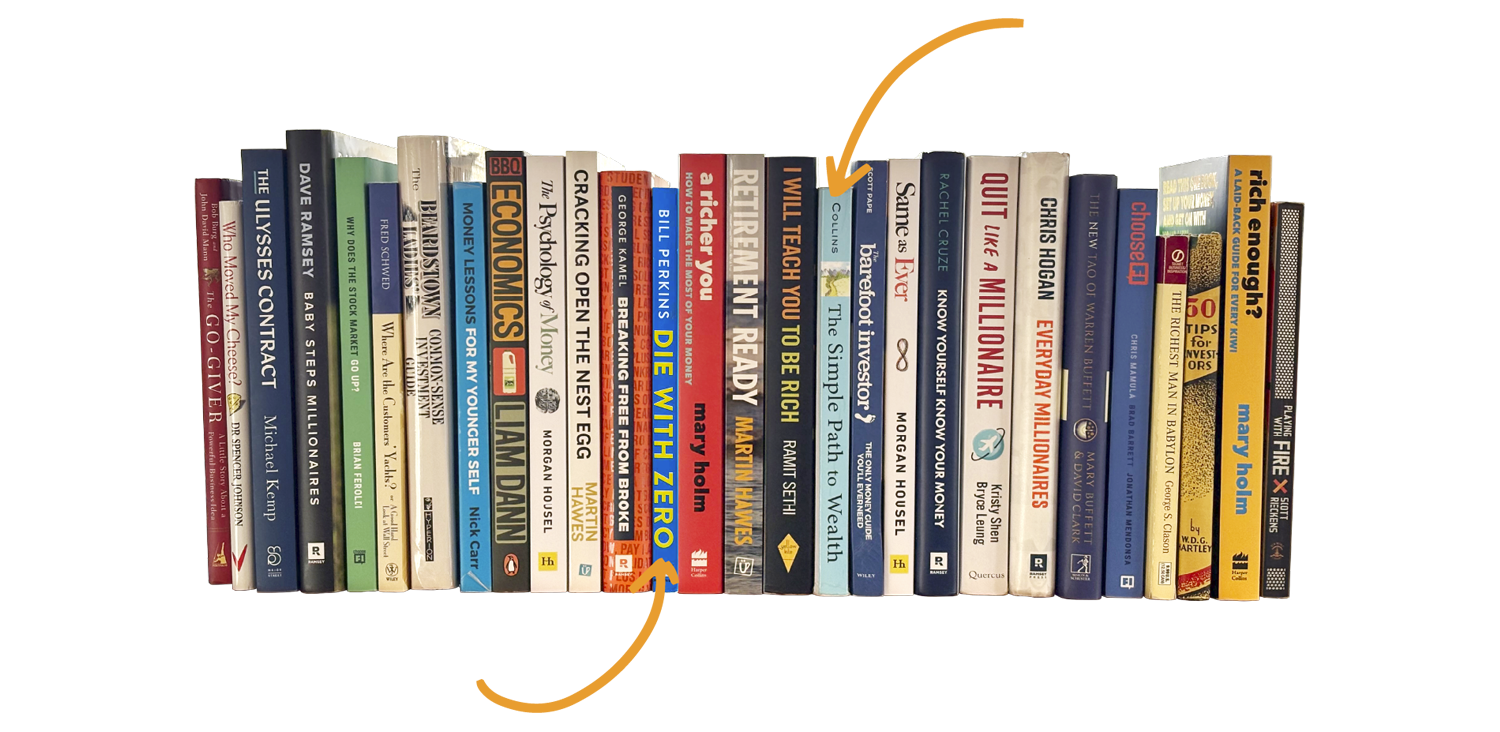
Some of the books on Ruth’s bookshelf and the two I’ve read.
Becoming debt-free changed everything.
For us, one of the biggest things money helped us do was pay off our mortgage in just five years, becoming debt-free.
That, and marrying Ruth, are probably my two best financial decisions.
I don’t think you fully understand what it feels like until you experience it, but when you stop sending a big chunk of your pay to the bank every month, you give yourself options.
Having a sense of FREEDOM is the only way I can describe it.
It made big decisions feel easier. Work became less important. I moved to four days a week, then took a year and a half off, and now I work two days a week. Soon, I’ll be in a financial position to stop entirely.
When the Christchurch earthquakes took out our house, we didn’t have to go and ask the bank what we could or couldn’t do. We just made a call and moved to Central Otago. Don’t get me wrong, it was still a big decision, but not one primarily focused on money.
It also meant I could be around more when our daughter was younger, and throughout her schooling, which was pretty special.
Looking back, sure, we probably could have paid the mortgage off even faster and started investing sooner if we’d known then what we know now. But I don’t regret those early years either. We travelled, did DIY projects, and bought the odd new car.
That was life at the time, and honestly, perfection wasn’t necessary.
And that’s probably the point. We didn’t do everything perfectly, but we got enough of the big decisions right, and we made them together.
People might assume that because Ruth runs a money blog, I’m right into all the details as well. I’m not. Ruth handles the investing side of things, but we talk about everything.
Every big spending decision, every investing decision, is discussed. There are no secret accounts, no hidden credit cards, and no his-and-hers accounts. We’re a team when it comes to money. We trust each other completely when it comes to money.
There is one small downside to joint bank accounts, though. Buying Ruth a birthday or Christmas present is almost impossible because she sees every transaction in PocketSmith. So now I load up a Wise card with an agreed amount and use that. She knows roughly what I’ve spent (because we discuss spending limits), just not what I’ve bought.
Surprise!
I don’t get into the weeds with money.
I’m just not interested in the nitty-gritty. What I care about is pretty simple: are we on track, are we heading in the right direction, what’s our net worth (is it growing), when can I quit work entirely, and how much is in the holiday fund?
Once a month, Ruth shows me the numbers. The PocketSmith “pinwheel” is about my level. It shows what’s coming in and where it’s going, and that gives me a good feel for things.
If something needs adjusting, we talk about it. If not, we carry on.
She also updates me on our net worth, which she tracks very enthusiastically in her spreadsheet. That’s enough for me. Simple.
Keeping it simple. My pinwheel in Ruth’s PocketSmith showing what we earn and spend.
Ruth's work vs Jonny's work
Just because Ruth handles the investing doesn’t mean I’m completely off the hook, though.
I’ve got my own money jobs.
I look at things like insurance (which she finds painfully boring) when it comes up for renewal, check subscriptions, and see if we can get a better deal. One of my go-to moves is starting the cancellation process with a provider to see if they’ll offer a discount to stay. About half the time, they do.
And yes, I spend a fair bit of time researching… mainly holidays: flights, trips, places to go. I enjoy organising that, but Ruth does not.
These days, my focus is pretty simple: I want to make work optional.
I currently work a PAYE job as a graphic designer two days a week, which I enjoy. I still do the odd freelance project too, which is a lot easier now that I use Hnry for the accounts side of things. It means I can pick and choose the work I do more easily, stop when I want to, and stay on top of the tax side of things without too much hassle.
But after falling off a ladder and breaking a few things, it was a pretty clear reminder that time and health matter even more than I realised.
I’m ready to stop working for money
I’m 53 now, and I don’t want to work until 65. No chance.
And from what I’ve seen through The Happy Saver, you don’t have to if you don’t want to.
The basics aren’t complicated:
become debt-free
spend less than you earn
invest consistently
keep it simple
That’s pretty much it.
Early retirement or ‘making work optional’, to me, doesn’t mean doing nothing. It just means having choices and the time to do all the other things I like.
More time. More travel. Fitness. Working with Ruth on the blog and podcast (I do all the ‘back-end’). Maybe a bit of freelance design work here and there. Family time. Getting into my workshop to create stuff.
We’ve met a lot of people over the years through the blog, and there’s a pattern.
Often, one partner is into money… and the other isn’t. That usually means one person is carrying most of the mental load, while the other stays disconnected from the bigger picture.
And more often than not, it’s the guy who isn’t that interested. I see the strain that it puts on the woman in the relationship.
What’s my advice to them?
Get interested enough to take part. You don’t need to become obsessed with money, but you do need to be involved. And you need to work out what an enjoyable life looks like to you.
You see it at our in-person meet-ups, too. Someone turns up on their own and says, “I wish my partner were here.”
Some guys are happy to spend money on cars, boats, bikes, and whatever else, but don’t really want to know how to manage day-to-day money or invest. Or if they do, it’s a bit of “fun” with individual stocks or crypto, or they say the Holden they’ve owned for 20 years is an investment.
Boring works!
Meanwhile, the idea of putting money into something simple like a total world fund and leaving it alone sounds boring.
But honestly, boring works really freaking well.
I also hear this a lot: “What would you even do if you didn’t work? Wouldn’t you be bored?”
No. You just end up doing things you actually want to do. I’ve transitioned out of work slowly, and I’ve reached a point where I easily fill my time.
Work towards the same goal, together.
If there’s one thing I’ve learned, it’s that life gets easier when you’re both moving in the same direction financially.
If one person is trying to get ahead while the other isn’t really engaged, it puts too much pressure on the person making the money decisions.
You both have skills and add to the conversation, so find a way to work together. In our case, Ruth does the research and works out what suits our family. I stay across the big picture, and we make decisions together. There are many times she puts a scenario to me, and I throw in a thought that hadn’t even crossed her mind. You make better decisions as a team.
That works for us.
I’m not a money expert, and I don’t want to be. But I’ve seen what happens when you get the basics right. I know what it feels like to have no debt, real options, and a bit more breathing room in life.
Spending less than you earn, investing regularly, and talking openly with your partner might not sound very exciting. But neither did paying off the mortgage, and that turned out to be one of the best things we ever did.
So, if you’re the less-interested person in your relationship, start small. Ask a few questions, look at the numbers, and have the conversation. You don’t have to become obsessed with money, but it’s worth paying attention to.
Because when you’re both in it together, life gets a whole lot easier.
Jonny
Final thoughts
Ruth here. I couldn’t help but chip in my two ten cents (inflation 😉).
I’ve noticed over the years that many couples don’t have money problems. They have relationship problems that lead to money problems. Talking honestly - and supportively - with each other is hard, but it helps. Week 5 of Rebel Finance School 2026 will include a specific session called Money Talks, and I really encourage couples to watch it together.
Working as a couple doesn’t mean you both need to know everything about everything. Aim to each have a general overview, while also having your own areas of expertise. Trust the other person to do their job while you do yours, then convene monthly to check in.
To the ‘numbers person’ in the relationship: don’t micromanage or bombard your spouse with data. Instead, think carefully about how your spouse prefers to communicate (and at what time of day), and present your knowledge accordingly. A good example is Jonny, who is a visual learner. He doesn’t willingly read money books, but he would watch the same information on YouTube. To meet him where he is, I have created a bespoke dashboard for him in PocketSmith. I asked him what he actually wanted to know about our money, and that is what I show him. Nothing more. I can add more detail if he asks.
My dashboard, on the other hand, is a thing of data-filled magnificence! Same information, bespoke presentation.
Jonny’s less data-filled bespoke PocketSmith dashboard compared to my more data-filled dashboard.
Money is rarely just about numbers. It’s about communication, trust, shared goals, and building a life that works for both of you. You don’t need to be perfect, and you don’t both need to love spreadsheets. You just need to keep talking, keep learning, and keep moving in the same direction - together.